TEACHER EDITION
Comparing Tens and Ones
Math Book 2 · sheet 3
Warm-up — yesterday: Counting by Tens or Ones
Count on by tens from 35, twice.45, 55
What we are learning
To compare two-digit numbers, compare the TENS first. Only if the tens are equal do the ones decide it.
How it is done — keep this beside you
These steps stay on your page while you work. If you get stuck, find the step you are on and read it again before you put your hand up.
1
Compare 43 and 38.
43 38
2
Tens first: 4 tens against 3 tens.
43 38
4 tens vs 3 tens
3
4 tens is more, so 43 is greater. The ones never mattered.
43 38
4 tens vs 3 tens
43 > 38
4
Now 43 and 47. The tens are the SAME.
43 38
4 tens vs 3 tens
43 > 38
4 tens = 4 tens
5
Only now do the ones decide: 7 is more than 3.
43 38
4 tens vs 3 tens
43 > 38
4 tens = 4 tens
47 > 43
Practice
I DOteacher builds it, nothing erased
Which is greater, 52 or 49?
- Tens: 5 against 4.
- 5 tens is more.
- 52 > 49
WE DO 1together, on whiteboards
Which is greater, 61 or 66?
Check the tens first — then decide whether you even need the ones.
- Tens are equal.
- Ones: 6 > 1.
- 66 > 61
WE DO 2together, on whiteboards
Which is greater, 28 or 71?
The ones look big on one of these. Do not let that decide it.
- Tens: 7 > 2.
- 71 > 28
YOU DOindependent, from the book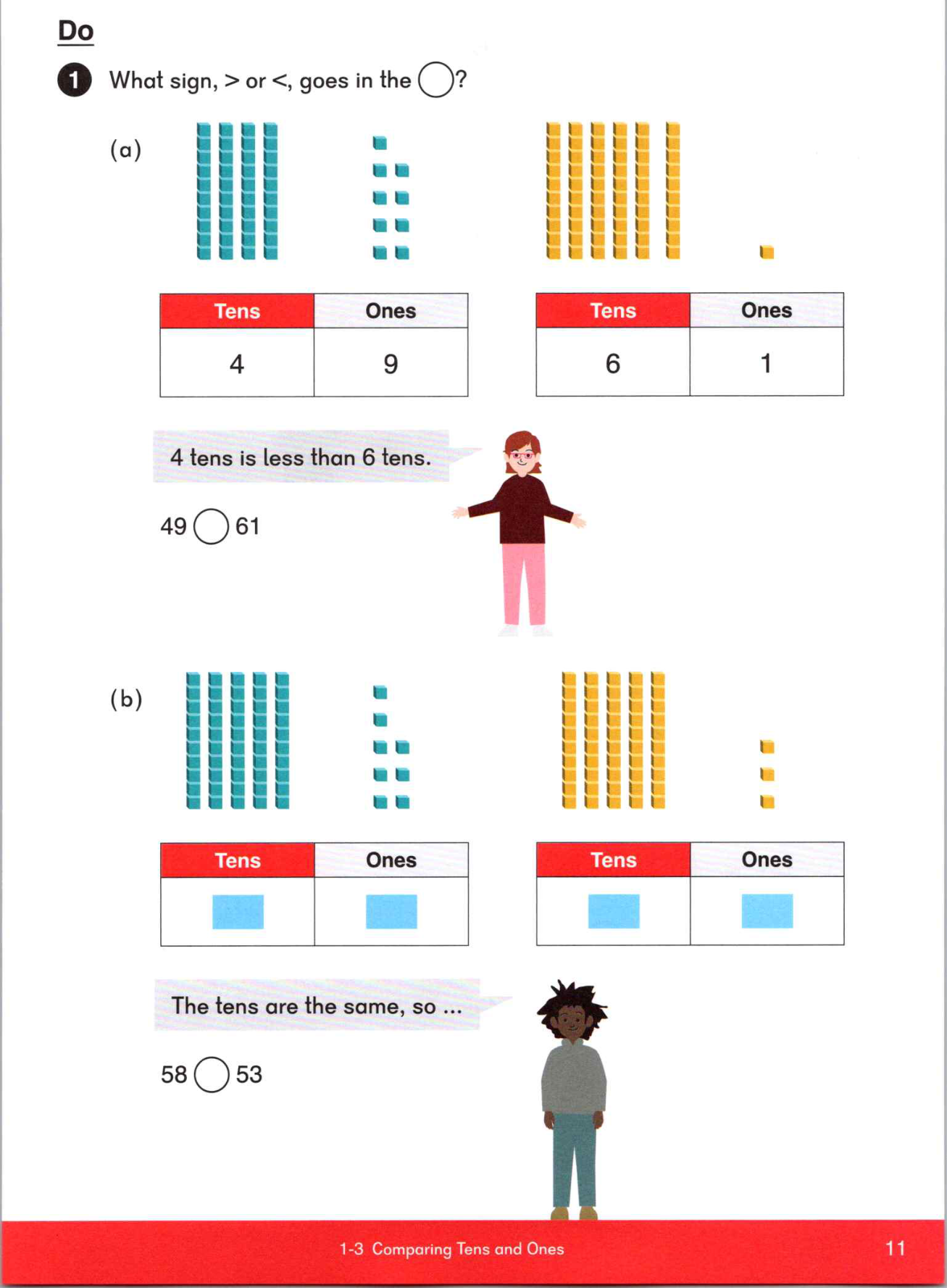
Book 2A p.12 — the Do section, clipped onto the slide
Ask yourself: “Have I compared the tens before I looked at the ones?”
Watch for
28 vs 71 is built as a trap: 8 is the biggest digit on the page and it is in the smaller number. A child who answers 28 has compared the ones first, which is the exact error this lesson exists to prevent.
28 vs 71 is built as a trap: 8 is the biggest digit on the page and it is in the smaller number. A child who answers 28 has compared the ones first, which is the exact error this lesson exists to prevent.