TEACHER EDITION
Numbers to 10,000
Math Book 3 · sheet 1
Warm-up
This is the first lesson of the year — there is nothing behind it yet. Begin at the big idea.What we are learning
Ten hundreds make one thousand. The pattern of the places keeps going.
How it is done — keep this beside you
These steps stay on your page while you work. If you get stuck, find the step you are on and read it again before you put your hand up.
1
Ten hundred-flats.
[100] × 10
2
Stacked, they make one thousand.
[100] × 10
[1000]
3
Three thousands.
[100] × 10
[1000]
[1000] [1000] [1000]
4
Two hundreds, four tens, six ones.
[100] × 10
[1000]
[1000] [1000] [1000]
3 thousands 2 hundreds 4 tens 6 ones
5
Written as a numeral, with the comma.
[100] × 10
[1000]
[1000] [1000] [1000]
3 thousands 2 hundreds 4 tens 6 ones
3,246
Practice
I DOteacher builds it, nothing erased
Write the number: 5 thousands, 1 hundred, 8 tens, 3 ones.
- Thousands: 5.
- Hundreds: 1. Tens: 8. Ones: 3.
- 5,183
WE DO 1together, on whiteboards
Write the number: 2 thousands, 7 hundreds, 4 tens, 9 ones.
Build it place by place, left to right. Boards up.
- 2,749
WE DO 2together, on whiteboards
Write the number: 6 thousands, 0 hundreds, 5 tens, 0 ones.
Two empty places here. Every place still needs a digit.
- 6,050
YOU DOindependent, from the book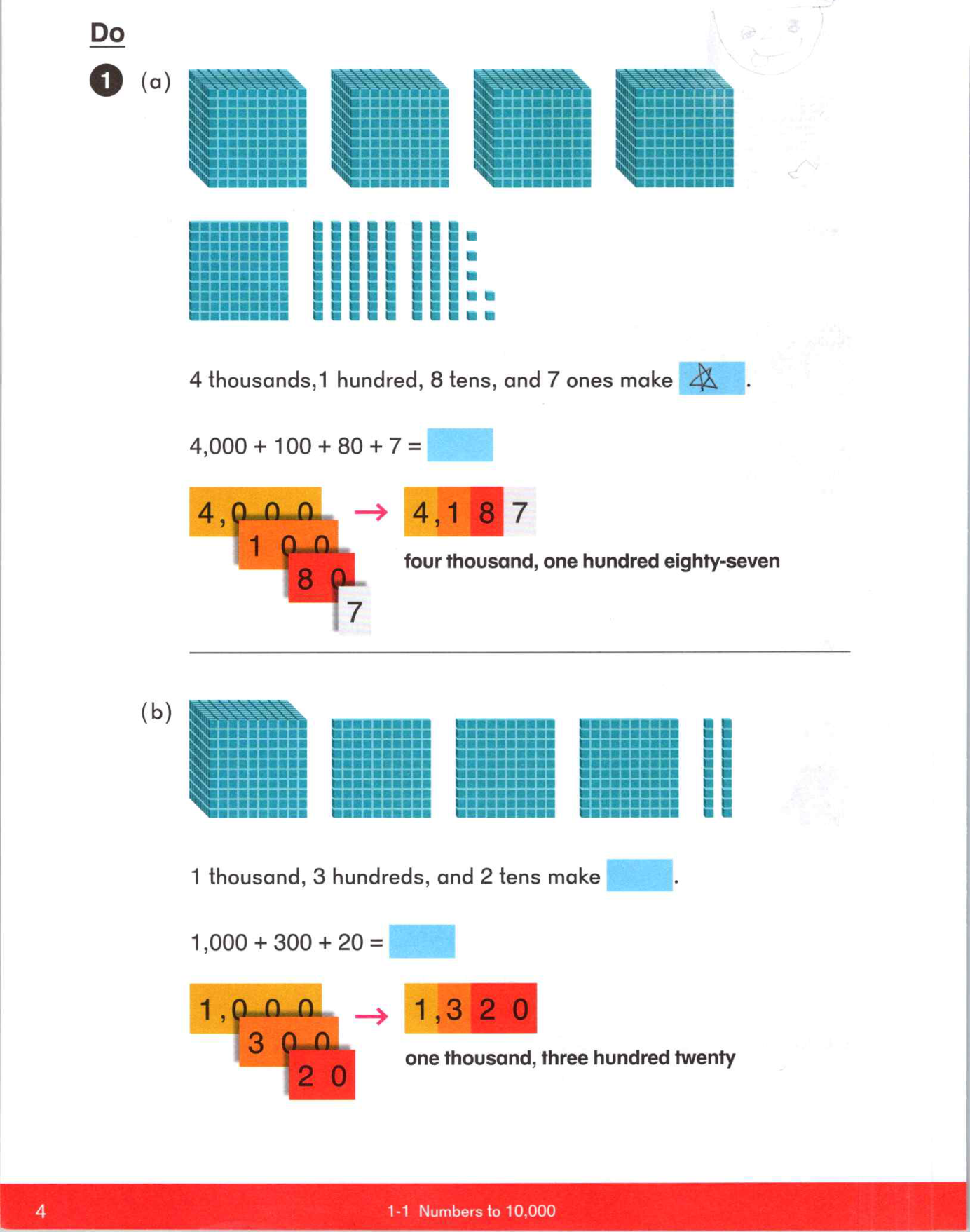
Book 3A p.6 — the Do section, clipped onto the slide
Ask yourself: “Does every place have a digit, even the empty ones?”
Watch for
6,050 has two zeros in different roles. A child who writes 650 has treated an empty place as no place at all — the single most consequential misunderstanding in place value.
6,050 has two zeros in different roles. A child who writes 650 has treated an empty place as no place at all — the single most consequential misunderstanding in place value.