STUDENT SHEET
Number Patterns
Math Book 4 · sheet 3
Warm-up — yesterday: Numbers to 1,000,000
What is the value of the 9 in 392,608?What we are learning
A pattern is a rule applied again and again. Find the rule from two steps, then check it against a third.
How it is done — keep this beside you
These steps stay on your page while you work. If you get stuck, find the step you are on and read it again before you put your hand up.
1
A sequence.
1,200 1,400 1,600 ___
2
From the first to the second: what happened?
1,200 1,400 1,600 ___
1,200 → 1,400 is +200
3
Check it on the next pair. Same jump.
1,200 1,400 1,600 ___
1,200 → 1,400 is +200
1,400 → 1,600 is +200
4
The rule is +200. It held twice, so I will use it.
1,200 1,400 1,600 ___
1,200 → 1,400 is +200
1,400 → 1,600 is +200
rule: + 200
5
Apply it.
1,200 1,400 1,600 ___
1,200 → 1,400 is +200
1,400 → 1,600 is +200
rule: + 200
1,600 + 200 = 1,800
Practice
I DOteacher builds it, nothing erased
What comes next? 3,500 4,000 4,500 ___
- 3,500 → 4,000 is +500.
- Check: 4,000 → 4,500 is +500.
- 4,500 + 500 = 5,000
WE DO 1together, on whiteboards
What comes next? 12,000 11,000 10,000 ___
Find the jump, then CHECK it on the second pair. Boards up.
WE DO 2together, on whiteboards
What comes next? 2,000 2,200 2,400 ___
Do not assume the jump from the first pair alone.
YOU DOindependent, from the book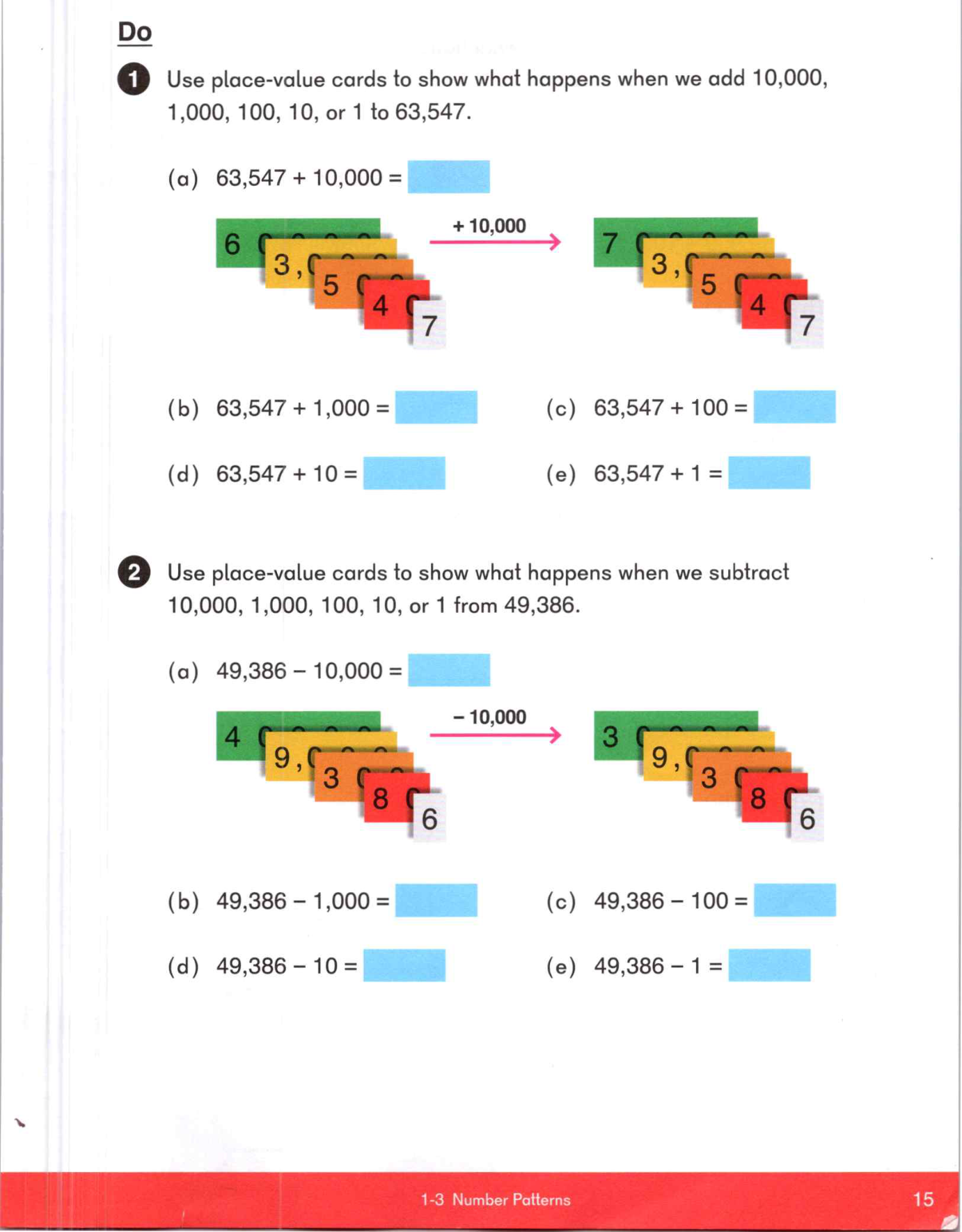
Book 4A p.16 — the Do section, clipped onto the slide
Ask yourself: “Did the rule hold twice, or did I only check it once?”