TEACHER EDITION
Multiplying by Tens, Hundreds, and Thousands
Math Book 5 · sheet 5
Warm-up — yesterday: Dividing by 10, 100, and 1,000
Show 6,300 ÷ 100.63
What we are learning
Multiplying by 30 is multiplying by 3 and then by 10 — a fact you know, followed by a shift.
How it is done — keep this beside you
These steps stay on your page while you work. If you get stuck, find the step you are on and read it again before you put your hand up.
1
4 × 30. I do not know this one directly.
4 × 30
2
But 30 is 3 × 10.
4 × 30
4 × 3 × 10
3
4 × 3 is a fact I know.
4 × 30
4 × 3 × 10
12 × 10
4
Now one shift left.
4 × 30
4 × 3 × 10
12 × 10
120
5
Fact first, shift second.
4 × 30
4 × 3 × 10
12 × 10
120
4 × 30 = 120
Practice
I DOteacher builds it, nothing erased
6 × 400
- 400 is 4 × 100.
- 6 × 4 = 24.
- Two shifts.
- 2,400
WE DO 1together, on whiteboards
7 × 50
Name the fact you are using before you shift. Boards up.
- 7 × 5 = 35.
- One shift.
- 350
WE DO 2together, on whiteboards
8 × 3,000
The fact is small. The shift is what makes it large.
- 8 × 3 = 24.
- Three shifts.
- 24,000
YOU DOindependent, from the book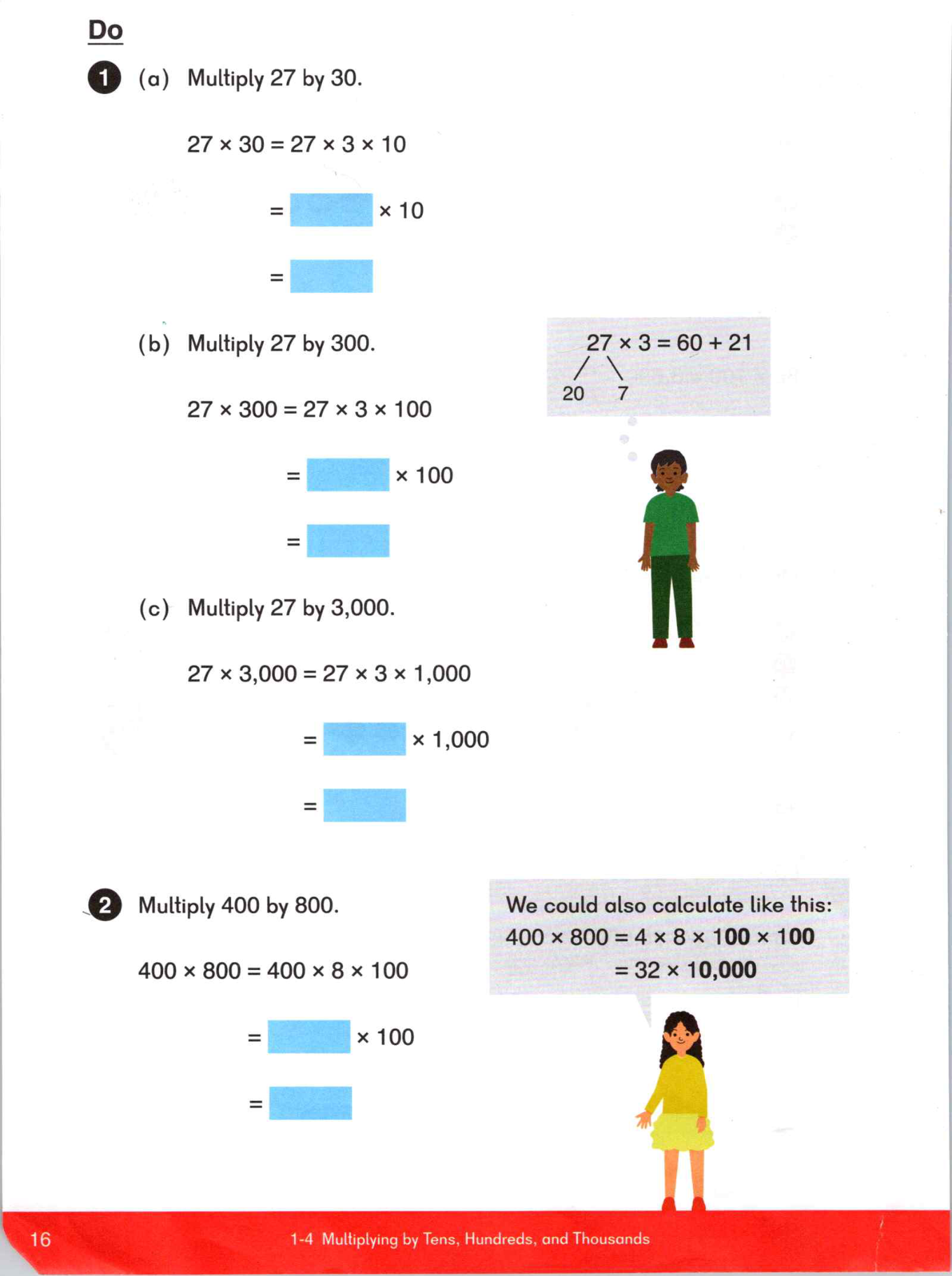
Book 5A p.15 — the Do section, clipped onto the slide
Ask yourself: “What is the fact, and how many shifts?”
Watch for
Children count the zeros in the answer rather than shifting, and 5 × 4 = 20 defeats them — 5 × 40 has TWO zeros in the answer from one shift. Fact first, then shift, and the problem disappears.
Children count the zeros in the answer rather than shifting, and 5 × 4 = 20 defeats them — 5 × 40 has TWO zeros in the answer from one shift. Fact first, then shift, and the problem disappears.