TEACHER EDITION
Order of Operations — Exponents
Math Book 6 · sheet 2
Warm-up — yesterday: Expressions and Equations
Is 9 − 3 = 6 an expression or an equation?An equation, and it is true.
What we are learning
An exponent counts how many times the base is used as a FACTOR — it is repeated multiplication, not multiplication by the exponent.
How it is done — keep this beside you
These steps stay on your page while you work. If you get stuck, find the step you are on and read it again before you put your hand up.
1
Repeated addition has a short form we know.
2+2+2 = 3 × 2
2
Repeated MULTIPLICATION needs a different short form.
2+2+2 = 3 × 2
2 × 2 × 2
3
We write it with an exponent.
2+2+2 = 3 × 2
2 × 2 × 2
2³
4
The 2 is the base — what is repeated. The 3 is how many factors.
2+2+2 = 3 × 2
2 × 2 × 2
2³
2³ = 2 × 2 × 2
5
Work it out. Note it is 8, not 6.
2+2+2 = 3 × 2
2 × 2 × 2
2³
2³ = 2 × 2 × 2
2³ = 8 (not 2 × 3)
Practice
I DOteacher builds it, nothing erased
Evaluate 3⁴.
- Four factors of 3.
- 3 × 3 × 3 × 3.
- 9 × 9 = 81
WE DO 1together, on whiteboards
Evaluate 5³.
Write out the factors before you multiply. Boards up.
- 5 × 5 × 5
- 125
WE DO 2together, on whiteboards
Evaluate 10⁴ and 4².
Two here. One of them is a common trap.
- 10⁴ = 10,000
- 4² = 16, not 8.
YOU DOindependent, from the book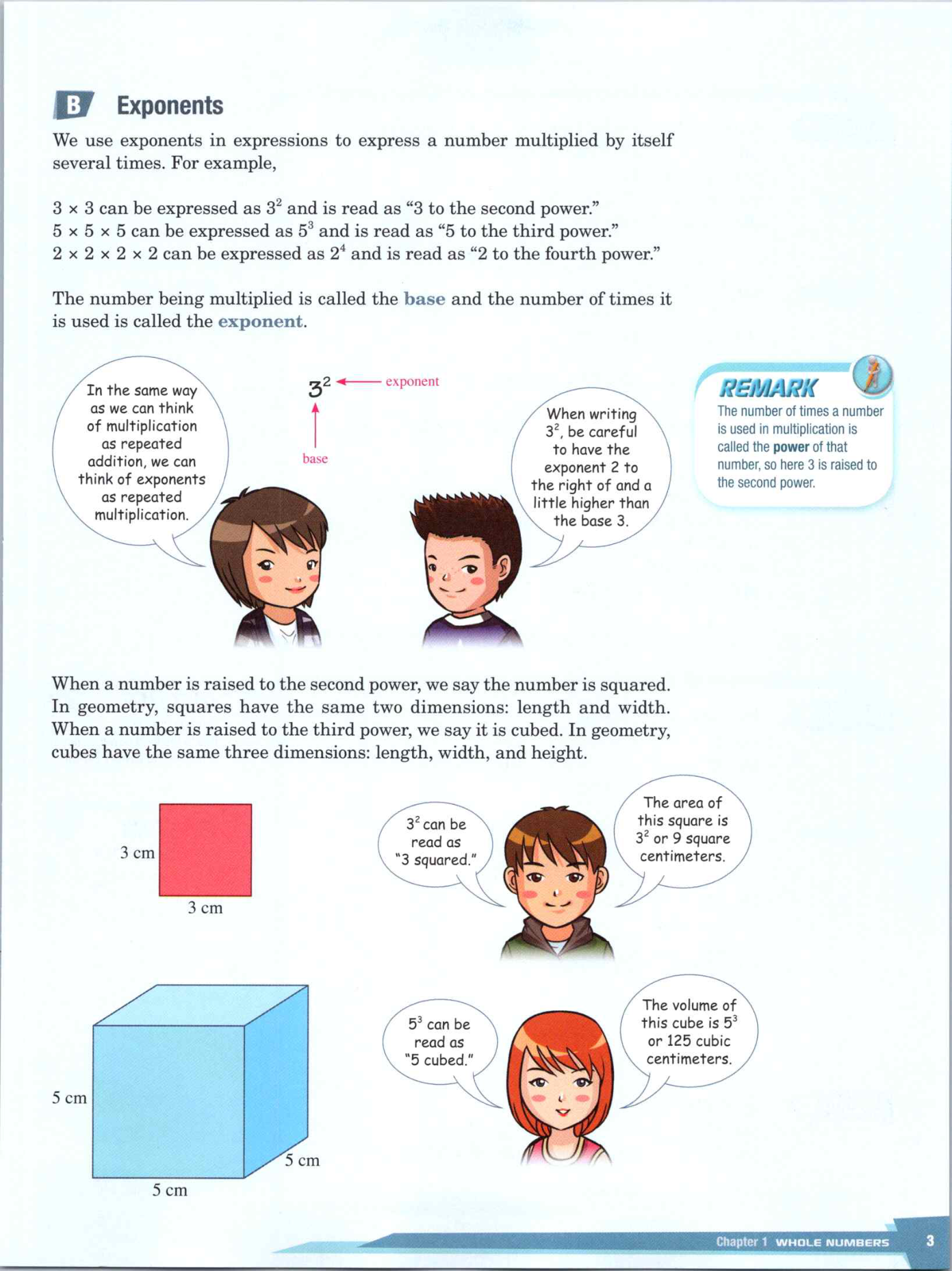
Book 6A p.3 — the Do section, clipped onto the slide
Ask yourself: “How many FACTORS, not how many to multiply by?”
Watch for
4² = 8 is the error, and it is nearly universal. Make them write the factors out longhand for the whole of this lesson — the shortcut can come when the meaning is secure.
4² = 8 is the error, and it is nearly universal. Make them write the factors out longhand for the whole of this lesson — the shortcut can come when the meaning is secure.