TEACHER EDITION
Order of Operations — without Parentheses
Math Book 6 · sheet 3
Warm-up — yesterday: Exponents
Evaluate 3³.27
What we are learning
Everyone must get the same answer from the same expression, so the order is agreed: exponents, then × and ÷ left to right, then + and − left to right.
How it is done — keep this beside you
These steps stay on your page while you work. If you get stuck, find the step you are on and read it again before you put your hand up.
1
Two days ago we met this.
8 + 2 × 5
2
Left to right gives 50. Multiplication first gives 18. Both cannot stand.
8 + 2 × 5
50? 18?
3
The agreed order settles it: × before +.
8 + 2 × 5
50? 18?
8 + 10
4
So the value is 18.
8 + 2 × 5
50? 18?
8 + 10
8 + 2 × 5 = 18
5
With an exponent, that comes first of all.
8 + 2 × 5
50? 18?
8 + 10
8 + 2 × 5 = 18
2 + 3² × 4 → 2 + 9 × 4 → 38
Practice
I DOteacher builds it, nothing erased
Evaluate 6 + 4 × 3.
- Multiplication first: 4 × 3 = 12.
- 6 + 12
- 18
WE DO 1together, on whiteboards
Evaluate 20 − 12 ÷ 4.
Which operation goes first? Say it before you write. Boards up.
- Division first: 12 ÷ 4 = 3.
- 20 − 3 = 17
WE DO 2together, on whiteboards
Evaluate 5 + 2² × 3.
Three operations. Take them in the agreed order.
- Exponent: 2² = 4.
- 4 × 3 = 12.
- 5 + 12 = 17
YOU DOindependent, from the book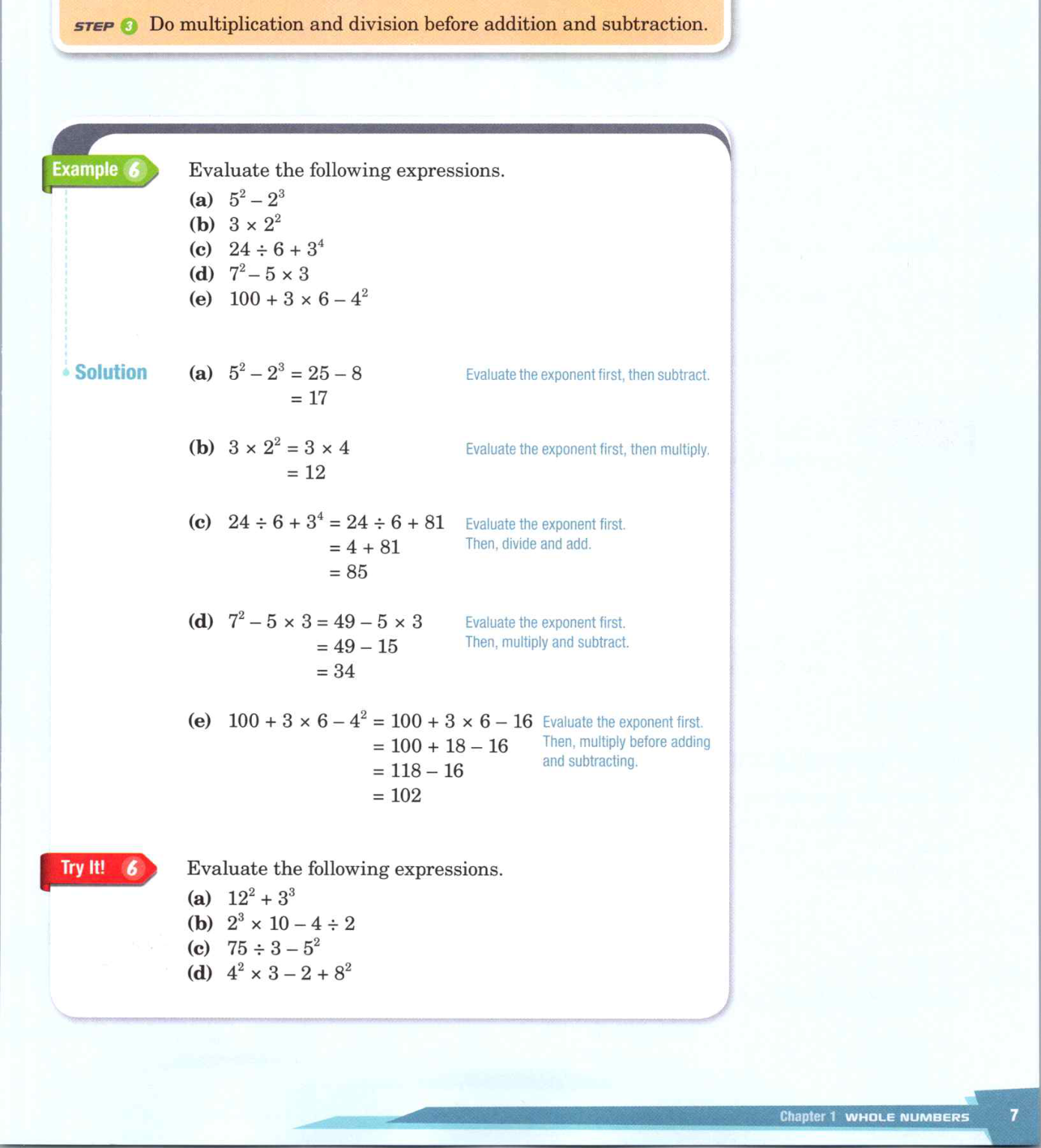
Book 6A p.5 — the Do section, clipped onto the slide
Ask yourself: “Which operation does the order say goes first?”
Watch for
This lesson answers the trap set deliberately in Lesson 1. Go back to that board photo if you kept it — a class that remembers being wrong remembers the rule.
This lesson answers the trap set deliberately in Lesson 1. Go back to that board photo if you kept it — a class that remembers being wrong remembers the rule.