STUDENT SHEET
Prime Factorization and Exponential Notation — Prime Factorization
Math Book 7 · sheet 3
Warm-up — yesterday: Multiples
Write the first four multiples of 11.What we are learning
Every whole number above 1 breaks down into primes in exactly one way. A prime has no factors but 1 and itself.
How it is done — keep this beside you
These steps stay on your page while you work. If you get stuck, find the step you are on and read it again before you put your hand up.
1
Break down 60. I take any factor pair.
60 = 6 × 10
2
Neither is prime, so I keep going. 6 = 2 × 3.
60 = 6 × 10
60 = 2 × 3 × 10
3
10 = 2 × 5.
60 = 6 × 10
60 = 2 × 3 × 10
60 = 2 × 3 × 2 × 5
4
All four are prime. I order them.
60 = 6 × 10
60 = 2 × 3 × 10
60 = 2 × 3 × 2 × 5
60 = 2 × 2 × 3 × 5
5
Starting from 4 × 15 instead gives the same primes. Always does.
60 = 6 × 10
60 = 2 × 3 × 10
60 = 2 × 3 × 2 × 5
60 = 2 × 2 × 3 × 5
unique: 2 × 2 × 3 × 5
Practice
I DOteacher builds it, nothing erased
Write 36 as a product of primes.
- 36 = 4 × 9.
- 4 = 2 × 2 and 9 = 3 × 3.
- 36 = 2 × 2 × 3 × 3
WE DO 1together, on whiteboards
Write 84 as a product of primes.
Any starting pair is allowed. Keep splitting until every factor is prime. Boards up.
WE DO 2together, on whiteboards
Write 45 as a product of primes.
One of these primes appears twice.
YOU DOindependent, from the book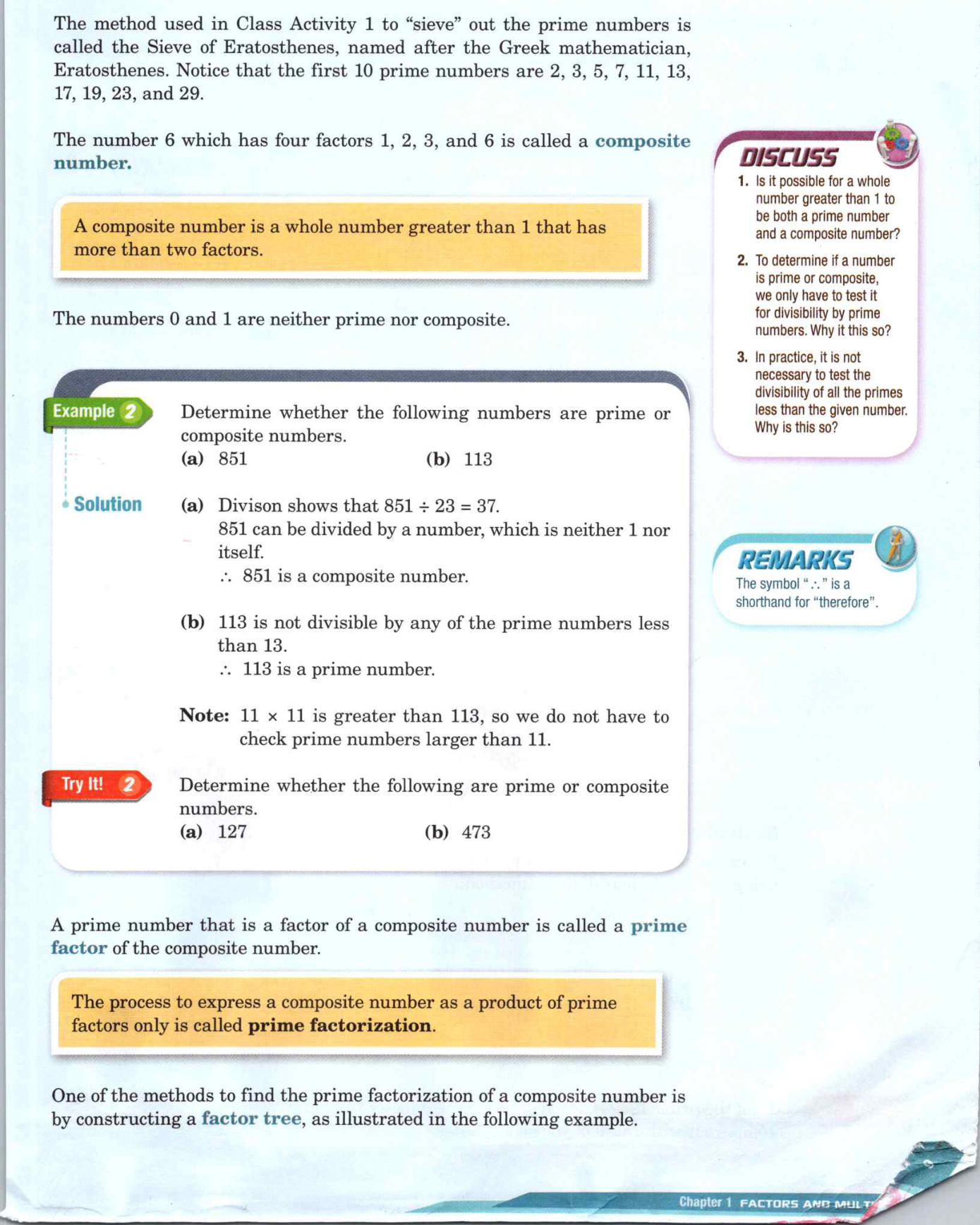
Book 7A p.4 — the Do section, clipped onto the slide
Ask yourself: “Is every factor on my list prime?”