STUDENT SHEET
Prime Factorization and Exponential Notation — Exponential Notation
Math Book 7 · sheet 5
Warm-up — yesterday: Prime Factorization
Write 40 as a product of primes.What we are learning
Exponential notation is a shorter way to write a prime factorization — and it makes the structure of the number visible at a glance.
How it is done — keep this beside you
These steps stay on your page while you work. If you get stuck, find the step you are on and read it again before you put your hand up.
1
The prime factorization of 72.
72 = 2 × 2 × 2 × 3 × 3
2
Count how many of each prime.
72 = 2 × 2 × 2 × 3 × 3
three 2s, two 3s
3
Three 2s is 2³.
72 = 2 × 2 × 2 × 3 × 3
three 2s, two 3s
2³
4
Two 3s is 3².
72 = 2 × 2 × 2 × 3 × 3
three 2s, two 3s
2³
2³ × 3²
5
Same number, and now the structure is visible.
72 = 2 × 2 × 2 × 3 × 3
three 2s, two 3s
2³
2³ × 3²
72 = 2³ × 3²
Practice
I DOteacher builds it, nothing erased
Write the prime factorization of 48 in exponential notation.
- 48 = 2 × 2 × 2 × 2 × 3.
- Four 2s and one 3.
- 2⁴ × 3
WE DO 1together, on whiteboards
Write the prime factorization of 100 in exponential notation.
Factorize first, then count each prime. Boards up.
WE DO 2together, on whiteboards
Write the prime factorization of 54 in exponential notation.
One prime appears once. Decide how to write it.
YOU DOindependent, from the book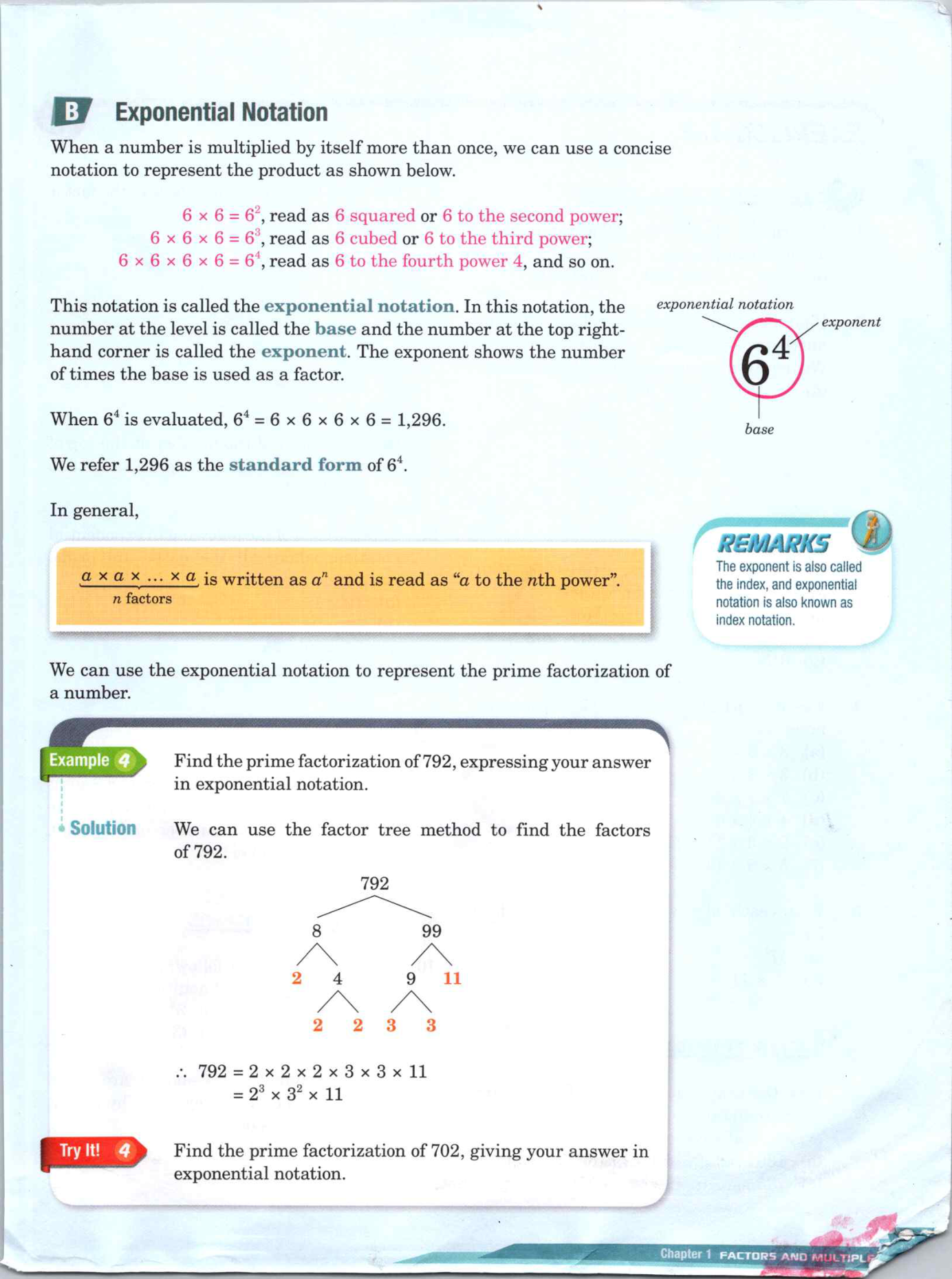
Book 7A p.7 — the Do section, clipped onto the slide
Ask yourself: “How many of each prime — and does a single one need an exponent?”